
Choosing the right outdoor light pole affects safety, visibility, maintenance, and the character of a property. A pole beside a parking lot faces different demands from one along a coastal walkway. Wind, moisture, vehicle impact, mounting height, and electrical access all matter. The best option is rarely chosen by appearance alone.
This guide examines the top types of Light Poles Outdoor, including steel, aluminum, fiberglass, solar, decorative, and high-mast designs. Each type offers a different balance of strength, weight, corrosion resistance, cost, and installation effort. Steel poles can support heavy fixtures and withstand demanding sites. Aluminum poles reduce weight and resist rust, but they may require careful structural evaluation. Fiberglass can perform well in corrosive environments, although its finish and long-term appearance deserve closer inspection.
Solar light poles may reduce trenching and utility dependence. Yet their performance depends on sunlight, battery capacity, shading, and seasonal weather. Decorative poles improve streetscapes, but ornate details can increase cleaning and repair work. High-mast poles cover broad areas, though installation often requires specialized equipment and accurate lighting calculations.
No single pole wins every site. Field experience shows that small specification mistakes can become expensive later. A polished finish may hide weak hardware. A low purchase price may create higher maintenance costs. Reliable selection should consider photometric plans, wind-load data, foundation requirements, corrosion ratings, and applicable local standards. Manufacturer documentation remains essential. Even experienced specifiers should revisit assumptions before approval.
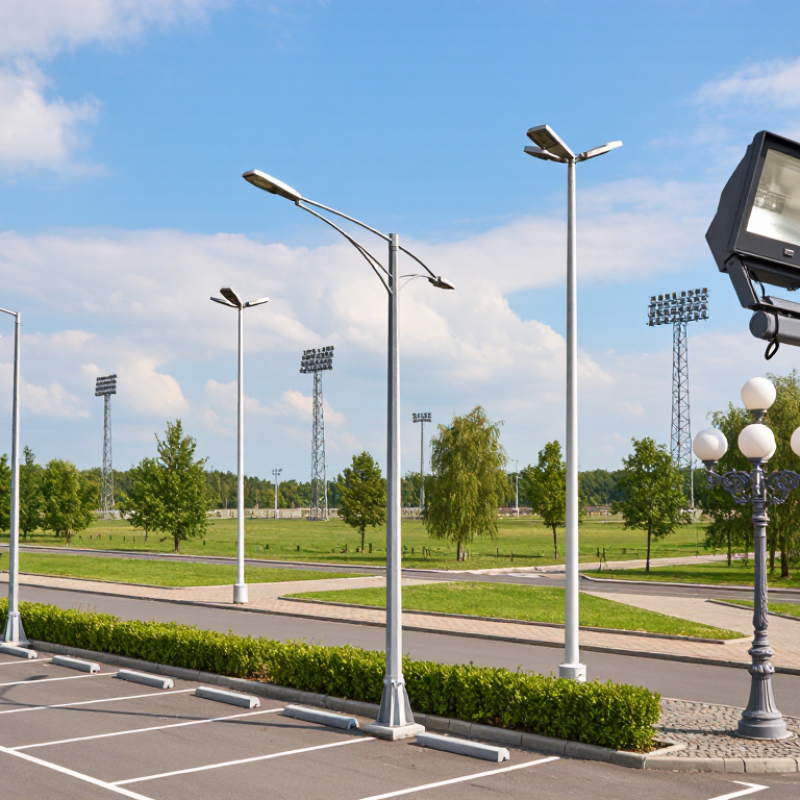
Outdoor light poles do more than hold a fixture above a road or walkway. They distribute light, protect electrical components, and improve visibility near entrances, parking areas, and public paths. Common types include straight poles, tapered poles, decorative poles, and high-mast systems. The right choice depends on mounting height, wind exposure, soil conditions, and the required lighting pattern. A tall pole is not automatically better.
A typical pole has a shaft, base plate, anchor bolts, handhole, wiring, and a luminaire bracket. The shaft carries vertical weight and resists bending from wind. The base transfers these forces into a concrete foundation, while the anchor cage keeps the assembly stable.
Steel offers strength and familiar fabrication, while aluminum reduces weight and can resist corrosion when properly finished. Concrete poles provide mass and durability, but transportation and installation can be demanding. Small details matter.
Their main functions are illumination, guidance, security support, and safer movement after dark. Good layouts limit glare and keep light on the intended surface instead of bedroom windows or neighboring properties. Engineers normally check photometric data, pole spacing, foundation capacity, cable protection, and local wind requirements. Maintenance access also matters because failed lamps, loose bolts, or damaged coatings can reduce performance quickly. In real projects, appearance sometimes receives more attention than serviceability.
No design is perfect. That choice deserves another look.
What Are the Top Types of Outdoor Light Poles?
Outdoor light poles must handle wind, moisture, impact, and years of maintenance. The right material depends on site conditions, not appearance alone. Steel poles provide high strength and suit tall installations, busy roads, and heavy fixtures. Galvanized or coated surfaces resist corrosion, but scratches can expose the metal. Regular inspection matters near salt air and deicing chemicals.
Aluminum poles are lighter and naturally resistant to rust. Crews can transport and install them with less lifting equipment. They work well in parks, walkways, and moderate-height lighting systems. However, aluminum can dent more easily and needs careful structural design in high winds. Fiberglass poles offer strong corrosion resistance and can reduce conductivity risks. They suit wet areas, marinas, and utility-sensitive locations. Their surface may fade or become brittle after prolonged ultraviolet exposure.
Concrete poles deliver stiffness, weight, and impact resistance. They fit highways, parking areas, and locations needing a low center of gravity. Yet transportation is difficult, foundations require careful planning, and repairs are rarely simple. Fit matters. Field inspections often reveal that the cheapest pole is not always the least expensive choice. A damaged finish, weak anchor system, or neglected base can shorten service life. Engineers should verify wind loads, soil conditions, fixture weight, drainage, and local codes before specifying a pole. I would not choose from a material chart alone.
| Material | Typical Density | Relative Weight | Corrosion Resistance | Typical Service Life* | Maintenance Needs | Common Applications | Key Advantages | Main Limitations | Relative Initial Cost |
|---|---|---|---|---|---|---|---|---|---|
| Steel | About 7,850 kg/m³ | High | Moderate to high when hot-dip galvanized, coated, or properly painted | Approximately 25–50 years, depending on coating, climate, and inspection | Periodic inspection for coating damage, rust, fasteners, and base connections | Roadways, parking areas, sports facilities, industrial sites, and high-mast lighting | High strength, excellent stiffness, broad size range, and good resistance to impact | Heavy; exposed or damaged coatings can allow corrosion | Low to medium |
| Aluminum | About 2,700 kg/m³ | Low | High in many outdoor environments because of its protective oxide layer; special care may be needed in marine or galvanically active locations | Approximately 30–50 years with suitable design and maintenance | Routine cleaning and inspection; check joints and dissimilar-metal connections | Streets, walkways, residential developments, parking lots, and coastal installations | Lightweight, corrosion resistant, easy to transport, and generally recyclable | Lower stiffness than steel and more susceptible to denting or deformation from severe impact | Medium |
| Fiberglass | Typically about 1,500–2,000 kg/m³ | Low to medium | Very high; does not rust and performs well in many corrosive environments | Approximately 25–40 years, depending on ultraviolet exposure, resin quality, and loading | Inspect for surface weathering, cracks, delamination, hardware condition, and foundation movement | Coastal areas, parks, pathways, utility corridors, and locations requiring electrical insulation | Nonconductive, corrosion resistant, lightweight, and suitable for harsh chemical or marine conditions | Can be vulnerable to ultraviolet degradation, impact damage, and localized delamination | Medium to high |
| Concrete | Approximately 2,200–2,500 kg/m³ | Very high | Generally good, but moisture, chloride exposure, freeze-thaw cycles, and reinforcement corrosion can cause deterioration | Approximately 40–75 years with suitable design, materials, and environmental protection | Inspect for cracking, spalling, exposed reinforcement, water infiltration, and foundation settlement | Highways, bridges, public infrastructure, utility corridors, and permanent installations | Excellent mass, stiffness, fire resistance, durability, and resistance to vehicle impact | Very heavy, difficult to transport or relocate, and potentially vulnerable to cracking or spalling | Medium to high |
Single-arm, double-arm, and decorative poles solve different outdoor lighting problems. Single-arm poles suit sidewalks, parking edges, and narrow roads. Their offset fixture directs light across one useful zone. This design can reduce visual clutter and simplify maintenance access.
Double-arm poles serve wider roads, medians, and large parking areas. Two fixtures improve symmetry and may reduce the number of poles required. However, spacing must follow photometric calculations, not appearance alone. IES RP-8-18 recommends evaluating illuminance, uniformity, glare, and veiling luminance for roadway applications. A visually bright road can still contain unsafe dark gaps.
Decorative poles add identity to plazas, campuses, and historic-style streets. Their value comes from proportion, finish, mounting height, and comfortable nighttime brightness. The U.S. Department of Energy’s 2023 Solid-State Lighting R&D Opportunities report identifies LED efficacy above 200 lumens per watt in laboratory packages, while many installed products perform lower in real conditions. Optics, dirt, temperature, and driver settings matter. The difference is visible. A decorative pole with poor shielding may create glare instead of character. DarkSky guidance also supports careful control of upward light and excessive blue-rich output. In practice, I would review the pole, fixture, spacing, and surrounding surfaces together. Designers sometimes overvalue appearance. That mistake deserves another look.
Solar, smart, and specialty poles are reshaping outdoor lighting projects. Solar poles combine photovoltaic panels, batteries, controllers, and efficient LED fixtures. They suit parks, pathways, remote parking areas, and locations with costly trenching. The IEA’s Renewables 2024 report recorded about 420 gigawatts of global solar capacity additions in 2023. That growth supports wider confidence in solar infrastructure. Still, winter shade can reduce charging performance. A larger panel is not always the best answer.
Smart poles add sensors, wireless controls, cameras, environmental monitors, or public connectivity. They can dim lights after midnight, detect movement, and report maintenance faults. The U.S. Department of Energy reports that LED lighting uses at least 75% less energy than incandescent lighting. Combining LEDs with adaptive controls may reduce waste further.
Specialty poles address unusual needs, including marine exposure, high winds, pedestrian-scale lighting, and historic streetscapes. Material choice matters. Aluminum is light, while galvanized steel often provides stronger impact resistance. The wrong foundation can undermine an excellent lighting plan.
Tips: Measure nighttime brightness, not only daytime appearance. Check solar access across every season. Specify battery replacement access before installation. Confirm pole height, wind loading, drainage, and cable protection with a qualified engineer. Smart features also need secure software updates and clear data policies. I would test one section first. Real users often reveal glare, shadows, or confusing controls that drawings miss.
Choosing an outdoor light pole starts with the site, not appearance. Common options include steel, aluminum, concrete, and fiberglass poles. Steel handles demanding roads and parking areas well. Aluminum weighs less and resists corrosion near coastal air. Concrete offers high mass, but transportation and installation can become expensive. Fiberglass is useful where electrical insulation and low maintenance matter.
Height, wind exposure, soil, and fixture weight require professional review. ASCE 7-22 provides wind-load criteria used to design poles and foundations in the United States. Ignoring local wind zones can create dangerous deflection or premature failure. Pole spacing also affects uniformity. The Illuminating Engineering Society recommends evaluating illuminance, glare, and uniformity together. Brighter is not always better. It may increase discomfort and wasted energy.
Tips:
Match the pole to the environment. Choose hot-dip galvanized steel for harsh industrial sites, or marine-grade aluminum near saltwater. Check the foundation design, anchor bolts, access doors, and cable routing before ordering. The International Energy Agency’s Energy Efficiency 2023 report notes that lighting uses roughly 15% of global electricity. Efficient LED fixtures can reduce demand, but pole design still controls useful light delivery. The U.S. Department of Energy’s solid-state lighting reports identify more than 200 lumens per watt as an important performance target. Real projects may achieve less because of optics, temperature, dirt, and aging. That gap deserves honest review.