
Doors &
Windows

10 Tips for Choosing the Best Cantilever Umbrella

A Cantilever Umbrella can turn a sunlit patio into a comfortable place to eat, read, or watch the afternoon pass. Choosing one is less simple than picking a fabric color. The base, canopy size, frame, tilt range, and available shade all affect daily use. A broad canopy may cover a dining table, yet it can feel awkward on a narrow balcony. Details matter.

This guide uses an illustrative comment from fictional outdoor-furniture specialist Lena Ortiz, not a verified quotation: “Measure the shade you need at lunchtime, not just the space the umbrella occupies.” It is a practical reminder, though one measurement cannot predict every season or shifting patch of sunlight. Real patios change throughout the day.

The ten tips ahead examine stability, materials, coverage, adjustment, maintenance, and value. They also consider how the umbrella will fit around chairs, walkways, and nearby walls. Check the product specifications, including the base requirements, before buying; a sturdy-looking pole alone tells you little about wind performance. And be realistic. No umbrella stays effortless in every condition, and a large canopy can catch gusts. The best choice is the one that suits your space, routine, and willingness to maintain it—not simply the most impressive model in a photograph.
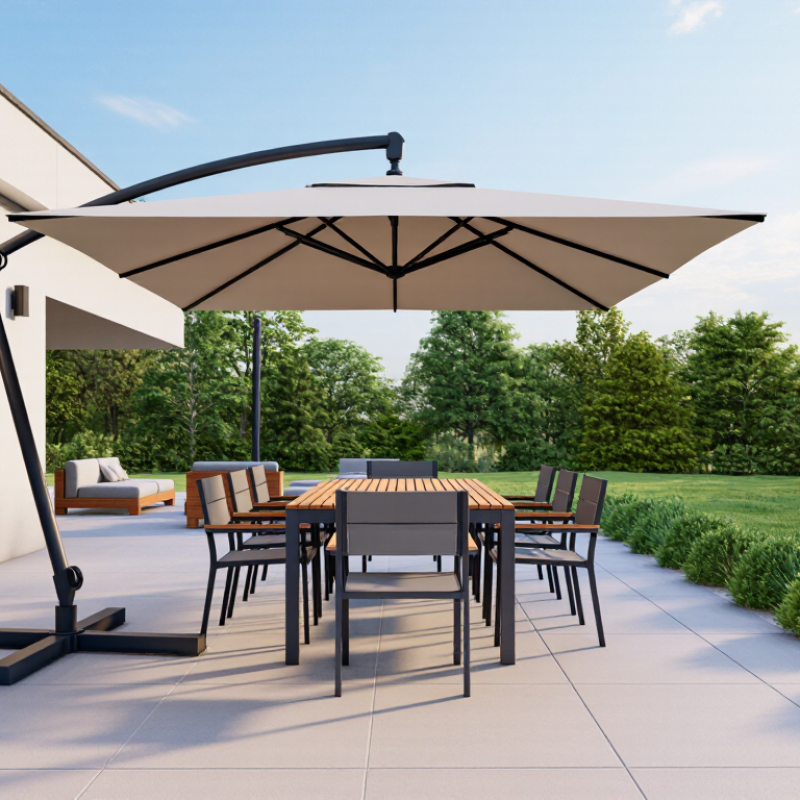
10 Tips for Choosing the Best Cantilever Umbrella

Assessing Your Space, Shade, and Placement Needs

Before choosing a cantilever umbrella, map the shade you need at breakfast, midday, and late afternoon. Mark the table, doors, and walking paths with chalk. Measure the canopy’s full reach, then check whether its support arm can rotate without hitting a wall or railing. A little awkward, but that test can reveal a poor fit.

Tip: The U.S. Environmental Protection Agency’s UV Index guidance classifies readings of 6–7 as high. Check your local forecast, then place the canopy where people actually sit during peak sun—not just where it looks tidy. Remember, an umbrella does not block every reflected ray from paving or nearby water.

Tip: Measure the base footprint and overhead clearance before ordering. Leave room to move chairs, open doors, and pass through safely. Note where afternoon wind funnels between buildings; a heavy base helps, but it does not make an open canopy storm-proof. Close it when conditions worsen. One detail is easy to miss: shade shifts, and your favorite seat may become sunny by 4 p.m. A quick chalk outline helps, though it cannot predict every gust.

Comparing Canopy Shapes, Sizes, and Materials

A square canopy provides broad, tidy coverage over a rectangular dining table, with fewer exposed corners. Its edges can help shade chairs placed around the table. Round canopies suit circular tables and soften the look of a compact patio. For a narrow balcony, a rectangular canopy may cover seating without extending far into a walkway. Shape matters.

Fabric affects both shade and upkeep. Solution-dyed acrylic often resists fading well, while polyester can be lighter and more affordable. Check the fabric’s stated UV protection and care instructions rather than judging by color alone. Dark fabric may feel more enclosed, though it can also show dust differently. I once underestimated how quickly pollen marked a pale canopy.

Measure the table and chairs together, then add space for people to pull chairs out. A canopy that barely covers the tabletop may leave diners in direct sun by late afternoon. For example, allow extra width beyond the table edges, and check the umbrella’s reach at different tilt angles. Larger canopies need a stable base and careful use in gusts; follow the maker’s wind guidance. Measure twice. A tape measure can still miss an awkward post or wall.

Evaluating Frame Strength and Weather Resistance

A cantilever umbrella places its canopy beside the pole, so the frame must handle uneven leverage. That load is easy to underestimate. Check the pole, ribs, and hub where the arms meet. They should feel firm, with no loose movement or sharp edges. A thick-looking pole alone proves little; connections and well-braced ribs matter just as much. Materials also affect upkeep. Aluminum resists rust, while coated steel can be strong but needs intact protection. Inspect welds, bolts, and moving joints for gaps or rough finishes.

Weather resistance depends on the whole setup, not just the canopy fabric. Look for fabric information on UV protection and water resistance, then check that seams are neatly finished. A quick look helps. One practical check is to open and close the umbrella several times; uneven movement may reveal a weak joint. Secure the base according to the maker’s weight guidance, and close the canopy when strong gusts are expected. Even a sturdy frame can twist under sudden wind. I would not assume “weather-resistant” means storm-proof; that wording can invite overconfidence. If the umbrella will stay outdoors, inspect coatings and fasteners occasionally, since small chips or loosened bolts are easy to miss until the frame starts to wobble.

Checking Base Stability, Rotation, and Tilt Features

A cantilever umbrella depends on its base as much as its canopy. Check the base’s stated weight and compatibility with the umbrella before buying; a large canopy can place substantial leverage on a narrow support. On a patio, inspect the surface too. Pavers, decking, and grass do not provide the same stability. The National Weather Service’s Beaufort Wind Scale classifies 25–31 mph as a strong breeze. That is not a safe operating target: close the canopy well before gusts approach it, and follow the product’s wind guidance. A sudden gust matters.

Tip: Test rotation and tilt with the canopy open in calm conditions. The turn handle should move smoothly, then lock without wobble. Tilt the shade and check whether the frame stays secure. Awkward to reach? That matters.

Before choosing, picture the sun moving across your seating area. A full 360-degree rotation can help redirect shade without dragging the base, while a dependable tilt mechanism can cover low afternoon sun. Check that controls remain reachable when chairs or a table are nearby. Also test the locking points; loose joints can make a stable base feel unreliable. The detail is easy to overlook. Recheck fasteners periodically, since use and weather can loosen them.

10 Tips for Choosing the Best Cantilever Umbrella

Check base stability, rotation, and tilt before comparing other features. The ratings below are practical guidance on a 1–5 scale, not product-test results or a market survey.

Weighing Maintenance, Warranty, and Overall Value

Maintenance and warranty can matter more than a low purchase price. Check whether the canopy detaches easily; a few minutes with a screwdriver should not become a half-day repair. Rinse dust and bird residue promptly, and let the fabric dry fully before storage. NOAA’s UV Index guidance classifies readings of 6–7 as high and 8–10 as very high. These readings describe exposure risk, not a canopy’s exact lifespan, but they help explain why sunny patios need more frequent fabric checks. Small detail: inspect the ribs and hub after gusty weather, not just the cloth.

Read the warranty line by line. Confirm whether it covers fading, stitching, frame corrosion, replacement parts, labor, and shipping; wind damage is often excluded. I still think warranty wording is easy to misread. A long coverage period may sound generous while excluding the canopy’s most likely wear. Compare the cost of a replacement canopy and available parts with the umbrella’s price. ASTM International’s G154 standard describes accelerated UV and moisture exposure testing for nonmetallic materials, but lab testing cannot predict exact patio performance. Ask whether fabric claims rely on standardized testing, then weigh that evidence against your local sun, rain, and storage conditions. A slightly pricier model with replaceable parts may offer better value, though only if those parts remain available.

10 Tips for Choosing the Best Cantilever Umbrella — Weighing Maintenance, Warranty, and Overall Value

Tip What to Evaluate What to Check Why It Matters for Value
1 Measure the space first Measure the seating or dining area, available clearance, and the umbrella’s full open footprint. Check the canopy dimensions and pole position in the product specifications. The right size provides useful shade without blocking pathways or doors. A canopy that is too small may not cover the intended area.
2 Check the base and mounting requirements Confirm whether the base is included, what base or anchoring method is required, and whether it is compatible with the umbrella. Follow the manufacturer’s installation instructions. The listed umbrella price may not include the base or other necessary components. Comparing the complete setup gives a more realistic total cost.
3 Assess frame materials and construction Review the frame material, finish, joint design, hardware, and available replacement parts. Look for clear care instructions and inspect product details for exposed or corrosion-prone components. Construction and finish affect how the frame holds up to regular outdoor use and how much attention it may need over time.
4 Compare canopy fabric carefully Check the fabric type, care instructions, UV-protection information, and whether replacement canopies are available. Compare specifications rather than relying on color or appearance alone. A well-documented fabric specification helps you judge comfort, upkeep, and future replacement costs. UV-protection claims should be supported by product information.
5 Test the operating mechanism Review how the umbrella opens, closes, rotates, or tilts. If possible, test the controls and check that the instructions explain operation and locking points clearly. An intuitive mechanism is easier to use regularly. A complicated or poorly documented system can make adjustment and everyday care less convenient.
6 Plan for wind and safe use Read the maker’s guidance on wind and operation. Close and secure the canopy when not in use and whenever conditions exceed the instructions; do not assume a particular wind limit applies to every model. Wind exposure can stress the canopy, frame, and base. Following model-specific guidance helps reduce damage risk and avoidable repair or replacement costs.
7 Understand the maintenance routine Check cleaning and storage directions. Many canopies can be cleaned with a soft brush, clean water, and mild soap when permitted by the care label; let fabric dry fully before covering or storing it. Simple, clearly explained care makes routine maintenance easier. Using unsuitable cleaners or storing damp fabric may damage materials or contribute to mildew.
8 Read the warranty details Compare the warranty period for the frame and canopy separately. Review who handles claims, proof-of-purchase requirements, and exclusions such as misuse, wind damage, fading, or commercial use. A warranty’s usefulness depends on its coverage and claim conditions, not just its length. Written terms help you understand potential out-of-pocket costs.
9 Check repairability and parts availability Ask whether the canopy, ribs, crank or other operating components can be purchased separately, and whether repair instructions or service support are available. Replaceable parts can extend the useful life of an umbrella and may cost less than replacing the entire unit after a component wears out.
10 Compare total ownership value Include the umbrella, compatible base or mounting hardware, delivery, care supplies, and likely replacement parts in your comparison. Consider how often you will use it and where it will be installed. The lowest upfront price is not always the lowest long-term cost. A suitable, maintainable model with clear support may offer better value over its useful life.