10 Tips for Choosing Film Faced Plywood Globally
Choosing Film Faced Plywood globally is not simply a price comparison. It is a performance decision made under pressure. Concrete panels may face rain, heat, repeated stripping, and rough handling. A weak surface can swell at the edges, transfer texture, or fail before the project ends. That is expensive. Sometimes, painfully so.
The FAO’s Global Forest Products Facts and Figures 2023 reports that global wood-based panel production remains close to 400 million cubic metres annually. This scale shows the importance of reliable sourcing, but it does not guarantee consistent quality. Product names can hide major differences in veneer grade, core construction, adhesive chemistry, film weight, and pressing accuracy. The European standard EN 636 and bonding guidance in EN 314-2 provide useful reference points, while ASTM-based testing can support project-specific verification. Standards help. They do not replace inspection.
Dr. Robert J. Ross, a widely cited forest-products specialist associated with the USDA Forest Products Laboratory, has emphasized: “Plywood performance begins with veneer quality, adhesive bonding, and the intended end use.” That principle should guide every supplier conversation. Ask for test reports. Examine panel edges. Check thickness at several points. Request production photographs when possible. A glossy film is not proof of durability. Neither is a low quotation.
These ten tips focus on details that buyers often overlook, including film weight, core balance, formaldehyde documentation, dimensional tolerances, reuse claims, packaging, and factory traceability. Some recommendations may seem obvious. They are still missed. Global purchasing requires evidence, careful questions, and a willingness to reconsider convenient assumptions.
Define Film Faced Plywood and Its Main Applications
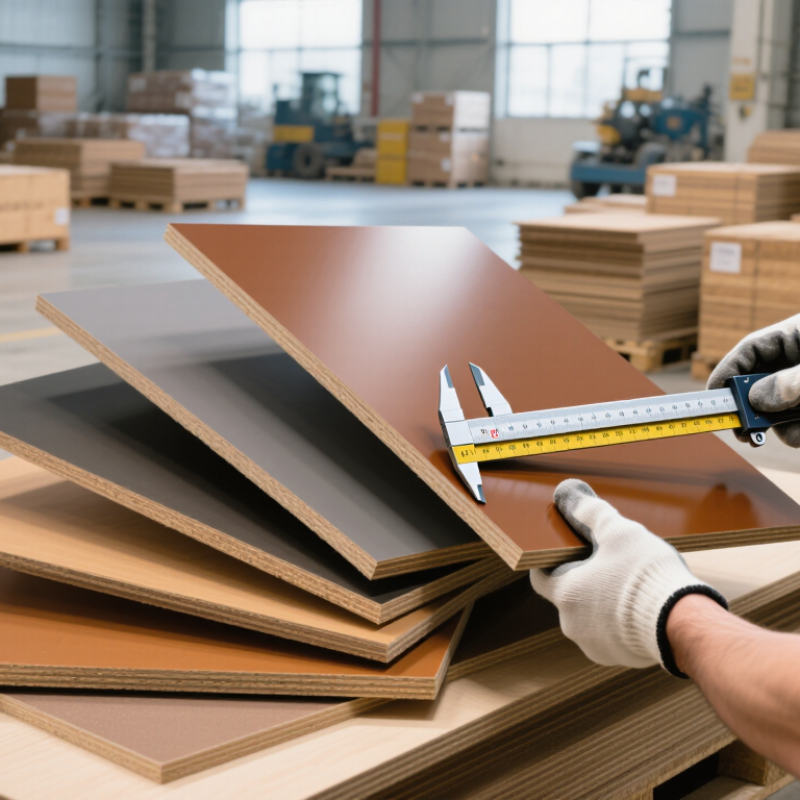
Film faced plywood is an engineered panel made from layered wood veneers and waterproof adhesive. Its surfaces are covered with a resin-treated film, usually dark or brown. This film creates a smoother, less absorbent face. It also helps concrete release from the formwork. The core provides strength, while the coating resists moisture, abrasion, and repeated handling. Quality still varies. Some panels look perfect but contain weak inner layers.
Its main application is concrete formwork. Contractors use it for slabs, walls, columns, and foundations. A dense film can produce a cleaner concrete finish. The panels are also useful for truck floors, warehouse platforms, temporary partitions, and reusable site structures. They should not be treated as permanent outdoor cladding without suitable edge protection. Water can enter through cuts, nail holes, and damaged corners.
Tip: Check the intended use before choosing a panel. For frequent formwork cycles, compare veneer quality, film weight, edge sealing, and bending strength. Ask for test reports from a reliable supplier, and inspect a sample by hand. Tap the surface and examine the edges. A practical trial often reveals more than a sales sheet. One caution matters: “waterproof” does not mean damage-proof. Store panels flat, raised above wet ground, and protect them from direct rain. I have seen careful projects lose usable sheets through poor storage, not poor manufacturing.
Assess Panel Quality, Core Materials, and Surface Film
Choosing film-faced plywood globally requires more than checking price or a dark, glossy surface. FAO and UNECE’s Forest Products Annual Market Review 2023 reports global wood-based panel production above 400 million cubic metres. That scale creates inconsistent quality between mills. Inspect panel edges for open veneers, core gaps, overlaps, and uneven thickness. Tap the sheet lightly. A hollow sound can indicate internal separation, although this test is imperfect. Small defects matter.
Core materials determine strength, stability, and reuse potential. Poplar cores are light, while hardwood cores usually provide better impact resistance. Mixed cores need careful inspection because density can change sharply across one panel. Check the technical sheet for veneer thickness, moisture content, bonding class, and allowable tolerances. EN 314-2 classifies plywood bonding durability, while ASTM D1037 includes tests for water absorption, thickness swelling, and mechanical performance. Ask for recent laboratory results, not only a certificate copied from an old shipment.
Surface film affects concrete release, abrasion resistance, and edge protection. Compare film weight in grams per square metre, resin impregnation, surface smoothness, and sealing quality. A heavier film is not automatically better; weak bonding can still cause peeling. Examine corners after cutting, where moisture enters first. In my purchasing work, I have accepted attractive panels that failed after repeated wet cycles. That mistake remains useful. Specify test conditions, storage time, and reuse expectations before ordering, because “waterproof” means little without a defined standard.
Compare Strength, Dimensions, Thickness, and Load Performance
Choosing film faced plywood for international projects requires more than checking a product label. Strength depends on veneer quality, core construction, glue performance, and surface condition. I have seen two panels with the same thickness behave differently under repeated concrete pours. A clean edge and tight veneer joints often reveal more than a glossy face.
Dimensions must match the formwork design and transport plan. Common sheet sizes are not identical across every market, so confirm length, width, squareness, and allowable tolerance before ordering. Small dimensional errors can create gaps around columns and slab edges. Measure carefully. It saves rework.
Thickness affects stiffness and load performance, but thicker is not automatically better. A well-built 18 mm panel may resist bending more effectively than a poorly bonded 21 mm panel. For heavy loads, compare span, support spacing, load duration, and moisture exposure. Bending stiffness rises sharply as thickness increases, yet fastener placement and edge support still matter. Ask for bending strength, modulus of elasticity, density, and water-resistance test data. Use the relevant local or project standard, not a generic online chart. I once underestimated deflection because the calculation ignored wet conditions. That mistake changed my inspection checklist. Load capacity should be verified by a qualified engineer when workers, high pours, or unusual spans are involved.
Verify Standards, Certifications, Moisture Resistance, and Safety
When choosing film faced plywood globally, begin with the project’s local standards and end-use demands. A panel for repeated concrete formwork needs different evidence from one used for temporary partitions. Ask for the applicable standard, test method, batch number, and certificate scope. Do not guess. Certifications should come from recognized independent bodies, not only a supplier’s brochure. Verify validity dates and whether the document covers the actual thickness, glue type, and factory.
Moisture resistance requires more than a dark, smooth surface. Inspect film adhesion around corners, sealed edges, and panel cuts. Ask for water absorption data and results from cyclic wetting tests. A good panel should resist swelling after handling, storage, and concrete contact. Still, no plywood is waterproof forever. Store sheets flat, raised from the ground, with covered ventilation. I once saw stacked panels ruined because rain entered through a torn cover. That simple failure was avoidable.
Safety checks should include formaldehyde emissions, slip performance when relevant, and clean cut edges. Request laboratory reports that identify sampling dates and test conditions. Review worker guidance for cutting dust, lifting weight, and damaged sheets. A certificate alone cannot reveal every production defect. Look for voids, delamination, uneven thickness, and exposed fasteners before installation. Photograph incoming pallets and record rejected pieces. This feels excessive. It often prevents disputes. Requirements differ across markets, so confirm them with a qualified local inspector.