
Doors &
Windows

What Is PUR Block Foam and What Is It Used For?

PUR Block Foam is a versatile polyurethane material produced in large buns or blocks, then cut into practical shapes. It is formed when polyols react with isocyanates, creating a cellular structure with controlled softness, density, and resilience. Most flexible grades contain interconnected cells, allowing air to move through the foam. This structure explains its familiar springy feel.

Industry research shows why this material remains commercially important. Grand View Research identifies flexible polyurethane foam as a major segment within the global polyurethane foam market, supported by furniture, bedding, automotive, and interior applications. The American Chemistry Council also describes polyurethane as a key material family used in comfort, insulation, and transportation products. However, market figures differ between reports because some include rigid foam, coatings, adhesives, or finished products. The numbers are useful, but not perfectly comparable.

In manufacturing, block foam may be sliced into mattress layers, sofa cushions, carpet underlay, acoustic panels, filters, and protective packaging. A warehouse worker might see the process clearly: a large foam bun enters a cutting line, while thin sheets leave with consistent thickness. Density and hardness must match the final use. Otherwise, a cushion may collapse early, or an acoustic panel may perform poorly.

Performance depends on formulation, cell structure, aging, humidity, temperature, and cutting accuracy. There is no universal grade. ASTM testing, supplier certificates, and application trials should guide selection. This practical caution matters because attractive specifications can hide weak long-term performance. PUR Block Foam is highly adaptable, but responsible buyers should verify test conditions, fire performance, emissions, and durability before approving it for production.
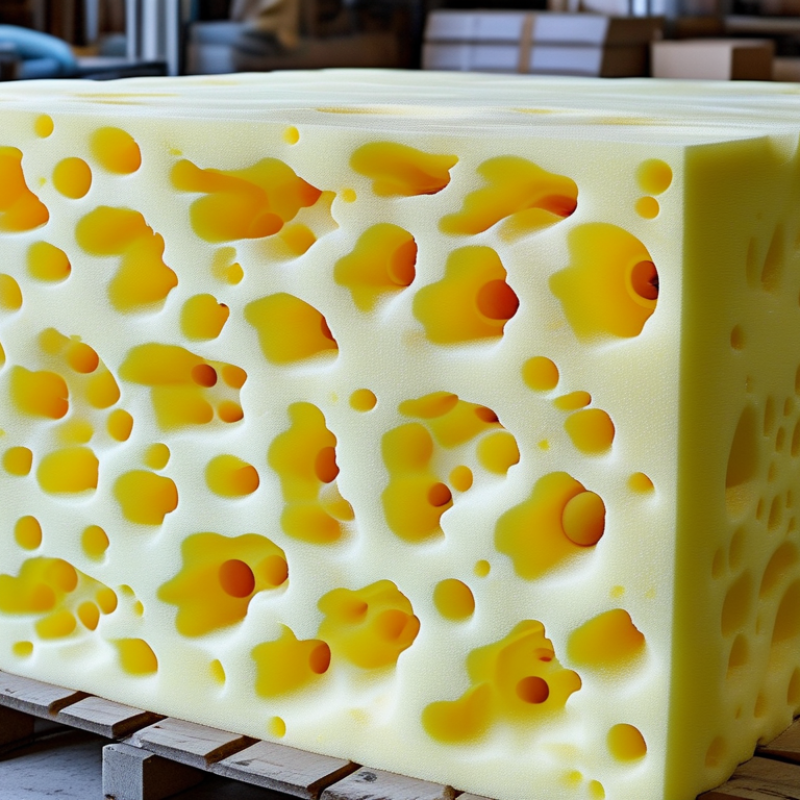
What Is PUR Block Foam and What Is It Used For?

Definition and Basic Structure of PUR Block Foam

What Is PUR Block Foam and What Is It Used For?

PUR block foam is polyurethane foam manufactured as a large, continuous block. PUR means polyurethane, a polymer formed by reacting polyols with isocyanates. During production, a controlled chemical reaction releases gas and expands the material. This creates millions of small cells throughout the block.

Most flexible PUR block foam has an open-cell structure. Each cell connects with nearby cells, allowing air to move through the foam when it is compressed. The soft, springy feel comes from these elastic cell walls.

A typical block may show a fine texture at the cut surface, although the structure is rarely perfectly uniform. Density, hardness, cell size, and resilience can change from the center to the edges.

The block is usually cut into sheets, rolls, cushions, pads, or shaped components. Its uses include seating, mattresses, acoustic panels, packaging inserts, filters, and protective padding.

Different applications require different grades. A seat cushion needs recovery after repeated pressure, while an acoustic panel depends more on airflow and surface area.

Simple visual inspection helps, but it cannot confirm performance. Testing is still needed for compression, durability, and fire behavior.

Even experienced users can misjudge foam by touch alone.

Temperature, moisture, and cutting quality also influence its service life.

How PUR Block Foam Is Manufactured

What Is PUR Block Foam and What Is It Used For?

PUR block foam is a polyurethane material produced in large, continuous buns. Manufacturers cut these buns into sheets, cushions, seals, packaging inserts, and acoustic components. Its density, firmness, resilience, and cell structure can be adjusted for different applications. A 2024 global polyurethane industry report estimated that flexible foam remains one of the largest polyurethane product segments, driven by furniture, bedding, transport, and insulation demand.

How PUR Block Foam Is Manufactured

Production begins by metering polyol, isocyanate, water, catalysts, and stabilizing additives into a mixing head. The liquid blend reacts quickly. Gas forms inside the rising foam, creating thousands of small cells. A conveyor controls the bun’s width and height while airflow and temperature influence its final structure. Operators then cure the block before cutting it with horizontal or vertical saws.

Small process changes matter.

According to technical data published by the European polyurethane industry association, foam density commonly varies across flexible grades, often from approximately 15 to 60 kg/m³. Lower-density foam feels softer, while higher-density grades generally support greater loads. However, density alone cannot predict performance. Compression testing, rebound testing, airflow measurement, and aging trials are also necessary. The ASTM D3574 test series is widely used for evaluating flexible cellular materials. Factory experience shows that uneven curing can create hidden density differences. That weakness deserves attention, especially when foam is used in load-bearing cushions or transport interiors.

Key Properties of PUR Block Foam

What Is PUR Block Foam and What Is It Used For?

Key Properties of PUR Block Foam

PUR block foam is polyurethane foam produced in large blocks, then cut into sheets, panels, or custom shapes. Its structure can be flexible, semi-rigid, or rigid, depending on the formulation and manufacturing process. This versatility supports uses in insulation, seating, packaging, filtration, and protective components.

Density strongly affects performance. Higher-density foam usually offers better compression resistance and longer service life. Lower-density grades feel softer and weigh less. The fine cellular structure can provide useful thermal insulation, while closed-cell versions resist water absorption more effectively. However, moisture resistance is not absolute. Joints, cuts, and surface damage can still allow water to enter.

PUR block foam is also easy to machine. It can be sawn, trimmed, laminated, or shaped for fitted applications. Its low weight reduces handling effort, especially when large panels are installed. Temperature stability depends on the grade, so engineers should check technical data before specifying it near heat sources. Fire behavior also varies and must be tested against the relevant project requirements.

In practical work, foam selection should match the actual load, temperature, humidity, and expected lifespan. A soft block may compress permanently under heavy equipment. A rigid grade may insulate well but feel unsuitable for cushioning. The mistake is assuming one foam meets every need. Small sample testing often reveals problems that a specification sheet misses.

What Is PUR Block Foam and What Is It Used For? - Key Properties of PUR Block Foam

Data Dimension Typical Property or Description Practical Significance and Common Uses
Material Type Flexible or semi-flexible polyurethane foam produced in large blocks The blocks can be cut, shaped, laminated, or fabricated into finished components for furniture, bedding, packaging, transport, and industrial applications.
Cell Structure Predominantly open-cell structure Open cells provide cushioning, airflow, and sound absorption. They also allow the foam to compress and recover under repeated loading.
Typical Density Approximately 15–60 kg/m³, depending on the formulation and intended application Lower-density grades are commonly used for lightweight cushioning, while higher-density grades generally provide greater durability, support, and load-bearing capability.
Hardness Range Available from soft to firm grades; hardness is normally specified by indentation force deflection rather than density alone This range allows manufacturers to select foam for soft seating, mattress comfort layers, automotive padding, protective packaging, or structural cushioning.
Compression Performance Compressible with elastic recovery; performance varies with density, hardness, temperature, and loading conditions Suitable for cushions, upholstery, mattresses, seating pads, gaskets, protective inserts, and other products that require energy absorption or comfort.
Resilience Generally moderate to high, depending on the foam grade Good resilience helps cushions and comfort products recover their shape after use and contributes to a responsive seating or sleeping surface.
Thermal Conductivity Typically low, commonly around 0.030–0.040 W/m·K for many flexible grades Low thermal conductivity provides a degree of insulation, although flexible PUR block foam is usually not selected as a substitute for purpose-made rigid insulation foam.
Air Permeability Generally high because of the open-cell structure Air permeability supports ventilation and moisture release, which is valuable in mattresses, upholstered furniture, vehicle seating, and comfort padding.
Sound Absorption Effective at absorbing airborne and reflected sound, particularly at middle and high frequencies Used in acoustic panels, equipment enclosures, interior trim, and sound-control components where reducing reverberation or reflected noise is required.
Water Behavior Open-cell foam can absorb and retain water unless treated, coated, or specially formulated Applications exposed to moisture may require drainage, protective coverings, hydrophobic treatment, or a closed-cell alternative.
Moisture and Humidity Resistance Usually suitable for normal indoor humidity, but prolonged moisture exposure can affect hygiene, weight, durability, and dimensional stability Proper ventilation and a moisture-resistant cover are important for mattresses, seating, packaging, and other products used in humid environments.
Temperature Resistance Performance depends on the formulation; extended exposure to high heat or very low temperatures can change flexibility and strength Manufacturers should verify the service-temperature range before using the foam near heat sources, in vehicles, or in temperature-controlled equipment.
Dimensional Stability Normally stable under recommended conditions, with possible changes caused by heat, humidity, compression, or aging Stable dimensions support accurate cutting and fitting in upholstery, packaging inserts, mattresses, and fabricated industrial parts.
Durability Good fatigue resistance when the correct density and hardness are selected Higher-quality or higher-density grades are often preferred for frequently used seating, mattresses, automotive interiors, and long-life cushioning products.
Processing Method Large blocks can be contour-cut, die-cut, split, peeled, laminated, or bonded Block production enables efficient conversion into sheets, profiles, cushions, mattress layers, packaging parts, filters, and custom-shaped components.
Furniture and Upholstery Used for seat cushions, back cushions, armrests, padding, and upholstered panels Different firmness and density combinations provide comfort, support, shape retention, and resistance to repeated use.
Bedding Products Used in mattresses, mattress toppers, pillows, and comfort layers The foam can provide pressure distribution, cushioning, ventilation, and varying levels of softness or support.
Automotive Applications Used in seat padding, head restraints, armrests, interior trim, and acoustic components Its low weight, cushioning capability, and formability make it suitable for vehicle comfort and interior noise-control parts.
Protective Packaging Used for cushioning inserts, edge protection, separators, and reusable protective pads The foam helps reduce impact transmission and protect sensitive products during handling, storage, and transport.
Industrial Components Used for seals, gaskets, vibration-damping pads, filters, polishing pads, and equipment padding Its compressibility, flexibility, and ability to be fabricated into custom shapes support a wide range of industrial designs.
Fire Performance Standard PUR foam is combustible; fire behavior depends on formulation, thickness, covering, and test method For transport, furniture, construction, or public-use applications, the finished product may need a tested flame-retardant grade and compliance with applicable regulations.
Recycling and End-of-Life Options Can be mechanically rebonded or processed into secondary products; recycling availability depends on local facilities and product design Designing for separation, minimizing contamination, and selecting suitable recovery routes can reduce waste from production offcuts and used foam.
Key Selection Factors Density, hardness, resilience, compression set, air permeability, fatigue resistance, temperature range, and fire requirements Choosing foam by application-specific test data is more reliable than selecting by density alone, because density does not fully define comfort, durability, or safety performance.

Note: Property ranges are typical general-purpose values and are not specifications for every PUR block foam grade. Final selection should be based on the manufacturer’s technical data sheet, the finished-product design, test requirements, and applicable safety standards.

Common Applications Across Different Industries

PUR block foam is polyurethane foam produced in large blocks, then cut into sheets, pads, or shaped parts. Its density and cell structure can be adjusted for comfort, insulation, or impact control. In practical manufacturing, operators choose foam by compression resistance, recovery, thermal conductivity, and moisture exposure. A softer grade may support a vehicle seat, while a denser grade can protect machinery during transport.

Construction remains a major application. Rigid PUR blocks are cut into insulation panels for walls, roofs, cold rooms, and pipe systems. The International Energy Agency reports that building operations use about 30% of global final energy. Better insulation can reduce heat transfer through these surfaces, although installation quality matters greatly. Small gaps, wet materials, or poorly sealed joints can weaken the expected performance. That detail is often underestimated.

Furniture and bedding producers use flexible block foam for cushions, mattresses, acoustic panels, and office seating. Automotive manufacturers apply it in seats, headrests, interior trim, and vibration-control components. Packaging converters cut it into protective inserts for instruments, glassware, and precision equipment. Industrial users also select PUR foam for filtration, gaskets, flotation aids, and thermal protection. A 2023 global buildings report from UNEP placed buildings and construction at roughly 34% of global carbon dioxide emissions, strengthening interest in efficient insulation materials. Yet foam selection should not rely on density alone. Service temperature, fire performance, recycling routes, and long-term compression loss deserve equal attention. Some applications still need better end-of-life planning.

What Is PUR Block Foam and What Is It Used For?

PUR block foam is polyurethane foam produced in large blocks and then cut into sheets, cushions, profiles, or molded components. The following chart shows typical density ranges used across common applications. Actual specifications vary according to comfort, load-bearing, thermal, acoustic, and durability requirements.

Factors to Consider When Selecting PUR Block Foam

What Is PUR Block Foam and What Is It Used For?

PUR block foam is polyurethane foam produced in large blocks and cut into sheets, pads, or custom shapes. Its open-cell structure can provide cushioning, airflow, sound absorption, or light filtration. Common uses include furniture padding, mattresses, protective packaging, acoustic panels, vehicle interiors, and industrial seals. However, “soft foam” is not a complete specification.

Factors to Consider When Selecting PUR Block Foam

Density strongly affects durability, weight, and cost. A low-density grade may feel comfortable but lose thickness faster under repeated loading. Firmness matters too, especially for seating, support pads, and protective inserts. Ask for measured hardness data rather than relying on labels such as soft or medium. Compression set testing can reveal whether the foam recovers after long pressure. It is an important detail.

Cell structure also deserves attention. Open cells improve ventilation, while finer cells can create a smoother surface and different cutting results. Check exposure to heat, moisture, oils, cleaning agents, and sunlight before choosing a grade. A foam that performs well indoors may weaken near machinery or windows. I have seen projects fail because only the first-day feel was tested.

Measure the required thickness, tolerance, and recovery time. Request technical data, batch information, and suitable safety documentation from a qualified supplier. Small samples should be tested under real temperature and load conditions. They often expose problems that product sheets miss. Cost should be reviewed with service life, waste, and replacement frequency, not alone.

Article Source: