
Doors &
Windows

China Top Double Doors Manufacturer for Global Buyers

Choosing the right China Top Double Doors Manufacturer requires more than comparing prices. Global buyers need dependable materials, accurate specifications, stable production, and clear communication. Double Doors may look simple, but their performance depends on frame strength, hinge quality, sealing, glass selection, and installation conditions.

This guide explores how experienced Chinese manufacturers serve commercial, residential, hospitality, and industrial projects. It examines factory capabilities, customization options, quality control, packaging, lead times, and export support. A reliable supplier should explain material grades, surface treatments, hardware choices, and testing methods without hiding important limitations. Ask for drawings, samples, inspection records, and references from comparable projects.

Details matter.

For example, a poorly protected corner can arrive scratched after a long sea journey. Uneven flooring can also affect opening and closing performance. These issues are not always caused by manufacturing, yet a professional supplier should help identify them early. Buyers should confirm dimensions, local building requirements, fire ratings, wind loads, and installation responsibilities before placing an order.

No supplier is perfect.

Even strong factories may face delays during peak seasons or encounter material shortages. Honest communication is more valuable than unrealistic promises. Buyers should review contracts carefully and request documented corrective actions when problems appear. This article offers practical guidance for evaluating manufacturers, reducing purchasing risks, and building a more reliable supply relationship with a China-based Double Doors partner.
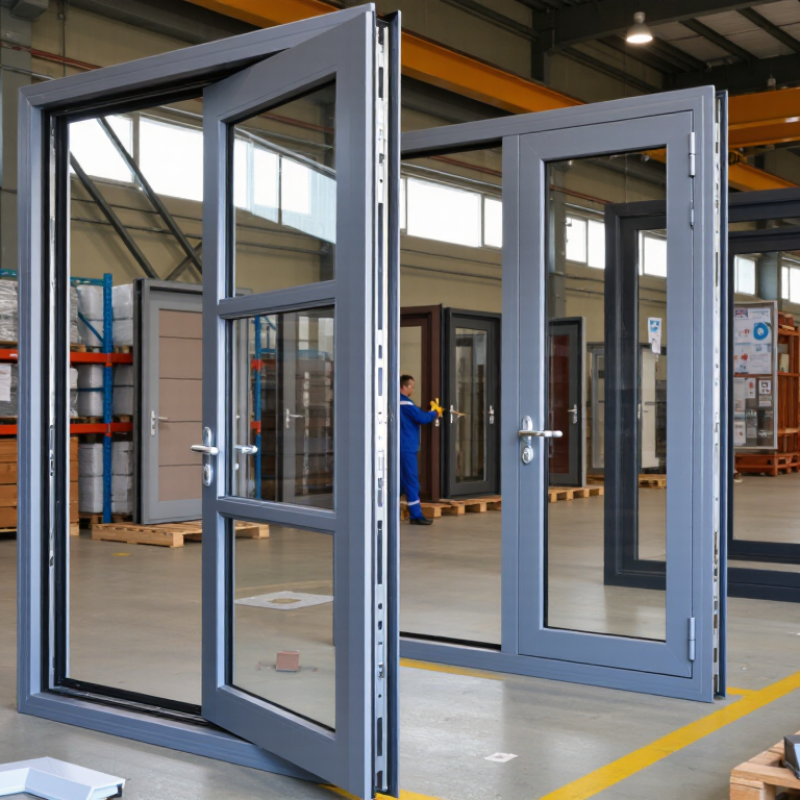
China Top Double Doors Manufacturer for Global Buyers

Defining Double Doors and Their Main Applications

Double doors are an entry system with two connected door leaves, usually meeting at the center. Both leaves may open, or one leaf may remain fixed during daily use. This design creates a wider clear opening than a single door. It also supports smoother movement for people, carts, furniture, and equipment. The frame, hinges, seals, and threshold must be selected as one system. A beautiful door can still perform poorly if these parts are mismatched.

Double doors serve different applications. In homes, they commonly connect living rooms with patios, gardens, or balconies. Large glass panels can bring daylight inside while maintaining a clear outdoor view. In offices, hotels, and public buildings, they help manage busy entrances and reception areas. Warehouses and workshops often need wider steel or insulated doors for pallet movement. Sound control, weather resistance, security, and thermal performance matter differently in each setting. A coastal entrance may need corrosion-resistant hardware, while a cold storage room needs strong perimeter seals.

In practical projects, opening width is only one measurement. Wall structure, traffic direction, floor level, and emergency access also affect the specification. A wider opening is not automatically better. It may increase weight, maintenance needs, and installation difficulty. We have seen plans focus on appearance and overlook daily operation. That mistake is avoidable. Buyers should request tested performance data, accurate drawings, and installation guidance before production. Door samples help, but real site conditions can still expose weaknesses.

China Top Double Doors Manufacturer for Global Buyers

Double doors are door systems formed by two coordinated leaves, allowing a wider passage than a single door. They are commonly used where accessibility, smooth traffic flow, furniture movement, or large equipment access is required.

The chart compares typical nominal overall widths frequently specified for double-door applications. Actual dimensions vary according to local building codes, accessibility requirements, fire ratings, hardware, and project conditions. A 32-inch minimum clear opening is commonly used as an accessibility reference for an individual door leaf under the U.S. ADA Standards.

Key Features of China’s Double Door Manufacturing Industry

China Top Double Doors Manufacturer for Global Buyers

Key Features of China’s Double Door Manufacturing Industry

China’s double door manufacturing industry benefits from a dense construction supply chain. The National Bureau of Statistics reported China’s construction output value exceeded RMB 31.5 trillion in 2023. This scale supports stable access to steel, aluminum, glass, hardware, coatings, and packaging materials. Buyers can often request custom widths, finishes, glazing, security levels, and opening systems from one production partner.

Factory capability is increasingly measured through process control. CNC cutting improves dimensional accuracy, while automated welding creates cleaner frame joints. Powder coating lines help produce more consistent surfaces. Many export-oriented factories also use inspection records for material thickness, hinge alignment, seal compression, and repeated opening tests. ISO 9001 certification can strengthen traceability, but certification alone does not prove excellent workmanship.

Logistics remains a practical advantage. China ranked 19th in the World Bank’s 2023 Logistics Performance Index, showing strong international freight connectivity. Yet quality is not uniform. Some suppliers still rely heavily on manual inspection, and sample doors may differ from mass production. A careful buyer should approve a golden sample, review tolerance data, and request photos from final inspection. Small details matter: a warped frame, weak carton corner, or poorly protected glass can create expensive claims. Mistakes still happen. Good manufacturers document them and improve the process.

China Top Double Doors Manufacturer for Global Buyers - Key Features of China’s Double Door Manufacturing Industry

Industry Dimension Common Industry Data or Practice Importance for Global Buyers Relevant Standard or Reference
Main Double-Door Types Aluminum double doors, steel double doors, stainless-steel doors, timber or timber-composite doors, glass double doors, fire-rated doors, and thermally insulated exterior doors. Allows buyers to match the door system with residential, commercial, industrial, hospitality, or public-building requirements. Product selection should be based on the intended application, local building regulations, and required performance classification.
Typical Configurations Equal active leaves, unequal leaves, center-hung doors, side-hung doors, French-style doors, and doors with fixed sidelights or transoms. Configuration affects opening clearance, hardware selection, accessibility, appearance, and installation space. The active leaf and inactive leaf should be clearly identified in drawings and purchase specifications.
Common Frame Materials Aluminum profiles are widely used for lightweight exterior systems; galvanized or painted steel is used where strength and durability are priorities; stainless steel is selected for corrosive or hygiene-sensitive environments. Material selection influences structural strength, corrosion resistance, weight, thermal performance, and maintenance cost. For aluminum doors and windows, buyers may reference GB/T 8478-2020 and applicable regional standards.
Glass Options Clear, tinted, laminated, tempered, low-emissivity, insulated, and frosted glass are commonly specified according to safety, daylight, privacy, and energy requirements. Glass selection affects impact safety, sound insulation, solar control, heat transfer, and total door weight. Safety glazing requirements should be checked against the destination market’s building and glass-safety regulations.
Thermal Performance Thermal-break aluminum systems, insulated glass units, low-conductivity spacers, weather seals, and insulated panels are used to improve energy performance. Thermal performance is especially important for exterior doors installed in hot, cold, or mixed climates. Request tested U-value or thermal-transmittance data for the complete door assembly rather than for the frame alone.
Weather Resistance Performance is normally evaluated through air-permeability, watertightness, and wind-load resistance tests for exterior door systems. Testing helps buyers assess suitability for exposed façades, high-rise projects, coastal locations, and regions with strong seasonal weather. China’s GB/T 7106-2019 covers performance testing for air permeability, watertightness, and wind-load resistance of building doors and windows.
Fire-Rated Applications Fire-rated double doors may use steel leaves, fire-resistant cores, intumescent seals, rated glazing, and self-closing hardware. Fire resistance is a regulated performance requirement and cannot be confirmed by appearance or material description alone. GB 12955-2008 is a commonly referenced Chinese standard for fire doors; destination-market certification may also be required.
Hardware and Security Typical hardware includes multi-point locks, cylinders, hinges, flush bolts, panic exit devices, door closers, pull handles, and access-control components. Hardware determines security, operating force, durability, emergency egress, and compatibility with local systems. Hardware should be specified by function, corrosion environment, cycle requirement, handing, and applicable local code.
Customization Capability Common customization items include opening dimensions, frame depth, glass type, surface finish, color, hardware, threshold, screens, louvers, and fixed panels. Customization supports project-specific architectural designs and regional construction practices. Approved shop drawings should define finished opening size, frame size, handing, tolerances, drainage, and installation details.
Surface Finishes Common finishes include powder coating, anodizing, fluorocarbon coating, galvanized coating, stainless-steel finishes, painted steel, wood veneer, and laminate surfaces. Finish selection affects color consistency, ultraviolet resistance, abrasion resistance, corrosion protection, and cleaning requirements. For coastal or industrial environments, request a finish specification and corrosion-resistance test information.
Quality-Control Stages Typical controls include incoming-material inspection, profile and panel checks, dimensional inspection, welding or assembly checks, coating inspection, hardware testing, and final visual inspection. Documented inspection reduces risks involving incorrect dimensions, damaged finishes, poor sealing, and hardware misalignment. Buyers should request inspection records, approved samples, test reports, and a pre-shipment inspection procedure.
Export Packaging Export packaging commonly uses protective film, corner protection, foam or honeycomb padding, cartons, wooden crates, or reinforced pallets, depending on door size and transport conditions. Proper packaging helps prevent scratches, glass breakage, frame distortion, moisture damage, and handling-related defects. Packaging should be agreed according to container loading, route, humidity exposure, lifting method, and destination customs requirements.
Buyer Documentation Important documents may include quotations, approved drawings, material specifications, packing lists, commercial invoices, certificates of origin, test reports, installation instructions, and maintenance information. Complete documentation supports customs clearance, installation, inspection, warranty administration, and building-code compliance. Required documents vary by destination country, project type, product classification, and contractual terms.

Note: The figures and practices above are general industry reference information. Final specifications, test methods, certifications, and compliance documents should be confirmed for the actual project and destination market.

Materials, Designs, and Customization Options for Global Buyers

China Top Double Doors Manufacturer for Global Buyers
Materials, Designs, and Customization Options for Global Buyers

Double doors for international projects require more than attractive photographs. Material selection affects stability, maintenance, and service life. Solid wood creates natural warmth, but it needs careful moisture control. Engineered wood offers better dimensional consistency in changing climates. Aluminum and steel provide slimmer profiles and strong weather resistance. Glass can brighten an entryway, yet its thickness and safety performance require professional verification.

Design choices should match the building, not follow temporary trends. Popular options include French doors, pivot doors, sliding systems, and traditional panel styles. Buyers can specify opening direction, frame depth, surface color, glass type, and hardware finish. Custom dimensions are possible. Accurate site measurements remain essential. A small error can complicate installation.

Practical experience shows that samples often reveal problems early. A finish may appear different under warm lighting. Handles can feel uncomfortable after repeated use. Packaging also deserves attention, especially during long-distance shipping. Reliable manufacturers should provide drawings, material details, inspection records, and clear production updates. They should explain tolerances instead of promising perfect results. Not every customization is equally practical. Very large glass panels, dark finishes, or unusual hardware may increase weight, heat absorption, or maintenance needs. Careful review helps global buyers balance appearance, performance, budget, and installation conditions.

How to Evaluate a Reliable China Double Doors Manufacturer

How to Evaluate a Reliable China Double Doors Manufacturer

A dependable China double doors manufacturer should provide more than attractive catalog images. Check its factory history, production equipment, and experience with overseas projects. Ask for evidence. Review material specifications, welding methods, surface treatments, and hardware options. A serious supplier can explain why aluminum, steel, or engineered wood suits different climates and building uses.

Request physical samples before approving a large order. Inspect frame alignment, hinge movement, locking points, seal compression, and glass installation. Details matter. Ask whether each door receives dimensional checks and opening tests before packing. Photos of the inspection process are useful, but independent inspection offers stronger evidence. Confirm packaging quality too. Corner protection, moisture barriers, and reinforced crates can prevent damage during long-distance transport.

Communication reveals practical reliability. The manufacturer should answer technical questions clearly, identify limitations, and provide drawings with exact measurements. Check production lead times, replacement policies, warranty terms, and export documentation for your destination market. Contact recent buyers when possible. A polished website is not proof of factory capability. I would also compare one approved sample with the final shipment, because small changes in profiles or finishes can affect installation. No evaluation is perfect. Even a well-organized supplier may face delays during peak production periods, so written milestones and realistic buffer time remain necessary.

Ordering, Quality Control, and International Shipping Considerations

China Top Double Doors Manufacturer for Global Buyers

Global buyers should treat a double-door order as a technical project, not a catalogue purchase. Send a signed specification before production. Include opening size, frame depth, swing direction, glass type, threshold design, and required performance ratings. A drawing prevents costly assumptions. Confirm the packing list against the purchase contract, including hinges, locks, handles, and spare parts.

Quality control should cover more than surface appearance. A practical inspection sequence includes material verification, weld checks, diagonal measurements, opening tests, coating inspection, and water or air performance tests when required. Sampling can follow ISO 2859-1 procedures. Photograph each inspected unit, especially corners and hardware fixing points. No inspection catches every risk. That deserves honest review.

Shipping requires realistic planning. UNCTAD’s Review of Maritime Transport 2023 states that ships carry over 80% of global merchandise trade. The World Bank’s Logistics Performance Index 2023 reported an average international shipment time of about 44 days from export port to destination. Build buffer time into contracts. Use moisture barriers, corner protection, and reinforced crates; confirm whether wood packaging meets ISPM 15 requirements. Agree on Incoterms 2020, document responsibilities clearly, and request pre-shipment photos. A minor label error can delay an entire container. Check it twice.